The idea in one paragraph
Every planet stands in a sign, and every sign has a ruler — the planet that governs it. The ruler of the sign a planet occupies is that planet's dispositor. Draw an arrow from each planet to its dispositor, then follow the arrows. Sooner or later they close into a loop. Whatever falls inside a loop is the core of the formula; everything else hangs off it in orbits, numbered by how many arrows away it sits. That is the entire construction. What comes out is not a wheel but a small diagram of dependence: which planets a person lives from, and which ones work for those.
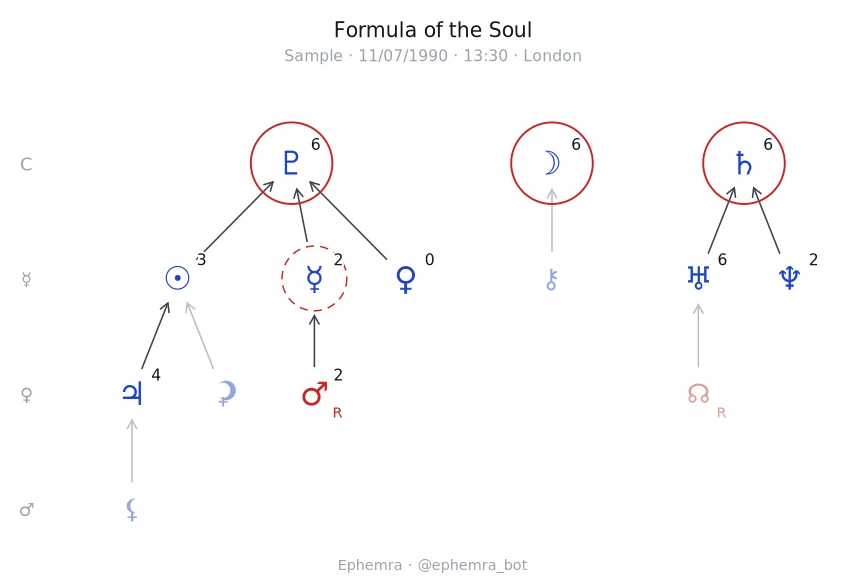
Following a dispositor chain, step by step
Say Venus stands in Aries. Aries is ruled by Mars, so Venus points at Mars. Mars stands in Capricorn, which Saturn rules, so Mars points at Saturn. And Saturn stands in Capricorn — its own sign. The arrow would point at itself, so the chain stops here.
Saturn — core · Mars — first orbit · Venus — second orbit
Chains can also close on two planets instead of one. If the Sun stands in Cancer and the Moon in Leo, each is standing in the other's sign: the Sun points at the Moon, the Moon points back at the Sun, and the loop shuts on the pair. In classical terms that is a mutual reception, and in this method both planets land in the core together.
A chart usually breaks into two or three such groups, so a formula is not required to have a single centre. Every dispositor chain ends somewhere: there is a finite number of planets, and the arrows have nowhere else to go.
What the core and the orbits mean
The core is read as what a person leans on and lives from: the qualities that need no permission from anything else in the chart. Planets on the orbits serve the core — the first orbit directly, the further ones through everything in between. A planet on the first orbit is close and immediate; one on the fourth reaches the core through three other hands.
Orbits also carry an age reading. The first is described as the one a person works through up to about twenty-one, the second between roughly twenty-one and forty-two, the third after that. Not a schedule — a rough order of what tends to come to the surface when.
Rest zones and alienation zones
Sometimes a planet stands alone in its own sign, closing a loop with nothing else joining it. It becomes a small separate core of its own. If the planet is moving direct, the method calls this a rest zone; if it is retrograde, an alienation zone. Both are read as a place where a person is self-sufficient — in the first case comfortably, in the second at a distance from everyone, which can be either strength or isolation depending on the rest of the chart. A formula can hold two or three of them.
How strong a planet is
Each planet gets a score from nought to six for how well it sits in its sign — the familiar ladder of dignities: at home, exalted, neutral, in detriment, in fall. The scores are then added up in groups: the personal planets, the social ones, the outer ones, and separately everything in the core against everything on the orbits.
The last comparison is the useful one. A heavy core and light orbits describe someone who relies mostly on themselves; light core and heavy orbits, someone whose strength arrives through circumstances and other people. Neither is better.
The cosmogram
The same scores can be drawn as a circle: twelve signs around the edge, planets placed by strength, the strongest nearest the centre. It answers a different question from the formula — not who depends on whom, but who is loud and who is quiet.
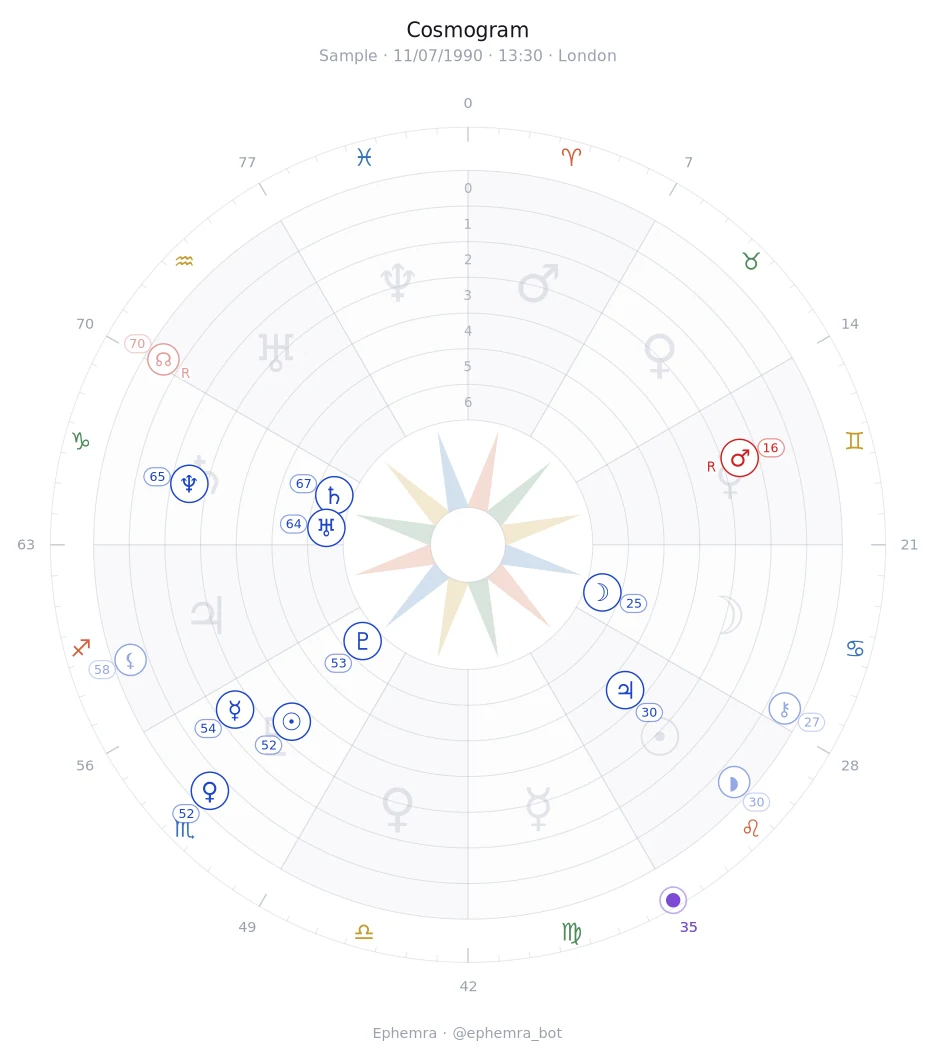
The wheel of fate
One part of the method does use degrees. Life is laid over the zodiac at seven years per sign, starting from Aries for everybody regardless of their Sun: Aries covers birth to seven, Taurus seven to fourteen, and so on around to Pisces at seventy-seven to eighty-four. A full turn is eighty-four years — the orbital period of Uranus.
A planet's activation age is where it falls on that wheel: the age its sign begins, plus its degree divided by the speed of the wheel. A planet at 22° of Virgo comes out at about forty. Signs with no planets in them are read as stretches where a person leans on themselves rather than on anything the chart hands them.
What the method leaves out on purpose
Houses, aspects and — apart from the wheel of fate — exact degrees play no part. Only the sign a planet stands in matters. This is a deliberate simplification, and it has a consequence worth stating plainly: the formula does not depend on where you were born, and two people born on the same day share one. The birth time changes it only when the Moon crosses into another sign during that day.
So the formula answers a narrower question than a natal chart, and a natal chart answers a narrower question than a life. That is why Ephemra builds both from the same details: the wheel gives you place, houses and aspects; the formula gives you the skeleton of dependence underneath them.
What it does not do
The method describes tendencies, not events. Astrogor's own framing is probabilistic — the formula points and warns, and the choice stays with the person. Nothing in it names a date, a diagnosis or an outcome, and nothing here should be read as advice, medical, psychological or financial.
Where it comes from
The method was published by A. A. Astrogor, in Russian, and is known mostly inside that language. Ephemra is not connected with its author or with any program that implements it: the rules of a method are not anybody's property, and this is our own implementation of them, written from the published books and computed from the Swiss Ephemeris. The wording of every reading here is ours.
See your own formula
A date, a time and a city. Your chart is built both ways — the natal wheel and the formula — and the first full reading is a gift.
Open in TelegramUnfamiliar words? The glossary explains every term this page uses.