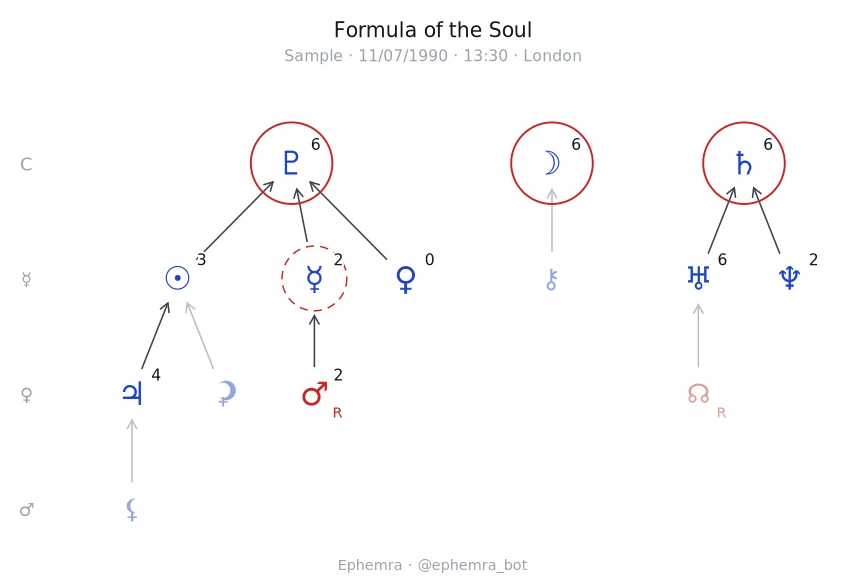
Read it bottom to top
The chart is built in rows. The top row is the core; everything below it is an orbit, and the further down a planet sits, the further it is from the core. Arrows always travel upward, because they always point toward the core. So the natural way to read the picture is from the bottom row up: this planet serves that one, which serves that one, until you arrive at what everything rests on.
The top row: circled planets
A planet drawn inside a circle sits in the core. There can be one, and there can be several groups of them — a chart usually breaks into two or three. The left margin marks that row with a C.
Circles are drawn as smooth closed lines because that is literally what the core is: a loop the arrows close on. Planets inside it depend on nothing else in the chart.
The rows below: orbits
Each lower row is one orbit, counted by how many arrows separate it from the core. The first orbit points straight in; the second reaches the core through the first, and so on.
The pale glyph in the left margin of each row is that orbit's ruler — the planet whose sign gives the row its number. It is a label for the row, not a planet standing there.
Arrows
An arrow runs from a planet to its dispositor: the ruler of the sign that planet stands in. Every planet has exactly one, so every planet has exactly one outgoing arrow — no more, no fewer. Following them always ends in a loop, which is how the core gets found in the first place.
Blue and red
Blue means the planet was moving direct at your birth; red means it was retrograde — apparently moving backwards against the stars, an effect of two orbits rather than anything actually reversing. Retrograde planets also carry a small R. This is the method's own convention, not our decoration, and the same colours are used in the books.
The number beside a glyph
That is the planet's strength, from nought to six: how well it sits in the sign it occupies, on the classical ladder of dignities. Six means it is at home or exalted; nought means it is in the sign that suits it least. The number says nothing about good or bad outcomes — only about how freely that planet works.
A dashed circle
A planet drawn in a dashed circle stands on the orbit that carries the number of its own sign — its own orbit. The method reads this as a planet working at full voice, whatever its score.
Planets standing alone in their own sign
A single planet closing a loop with nobody joining it becomes its own small core. Direct, it is a rest zone; retrograde, an alienation zone — self-sufficiency, comfortable in the first case and at a distance from everyone in the second. On the picture they look like a core with one occupant, and a chart can hold two or three.
The pale glyphs
Chiron, the lunar nodes, Black Moon Lilith and the White Moon are drawn faint on purpose. They are fictitious points: in this method they only point at things. They never enter the core and they carry no strength score.
The line under the title
Every image repeats the birth details it was built from — date, time and place. If the time was unknown it says so plainly and the chart is cast for noon, because a picture gets forwarded on its own and should be able to explain itself.
Next: how the formula differs from a natal chart, or the wheel of fate — the part of the method that deals in ages. Every term used here is in the glossary.