Seven years to a sign
A life is laid over the zodiac at seven years per sign, and the count starts from Aries for everybody — regardless of the sign you were born under. Aries covers birth to seven, Taurus seven to fourteen, Gemini fourteen to twenty-one, and so on.
Cancer 21–28 · Leo 28–35 · Virgo 35–42
Libra 42–49 · Scorpio 49–56 · Sagittarius 56–63
Capricorn 63–70 · Aquarius 70–77 · Pisces 77–84
A full turn is eighty-four years — the orbital period of Uranus. That is not a coincidence dressed up as one: the cycle was chosen for it.
The activation age of a planet
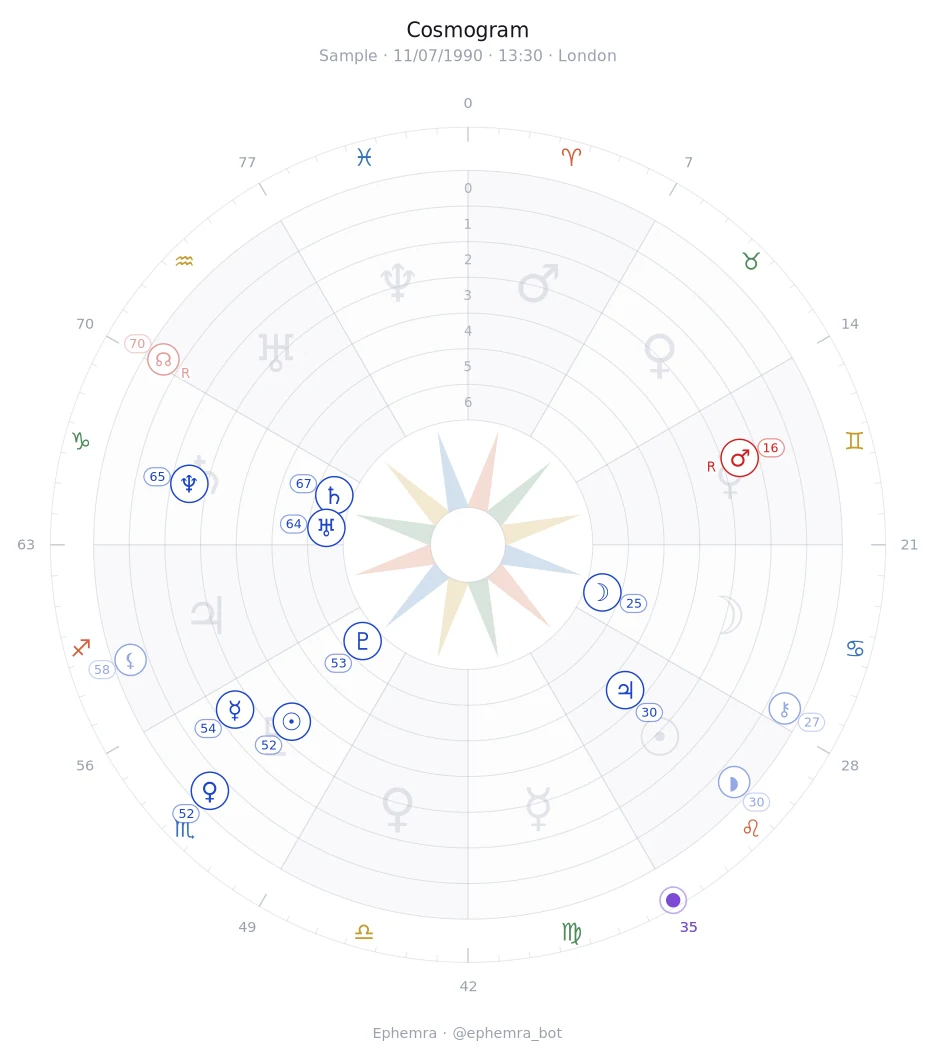
The wheel moves thirty degrees in seven years, so a shade over four and a quarter degrees a year. A planet's activation age is the age at which the wheel reaches it: the age its sign begins, plus its degree divided by that speed.
Virgo begins at 35 + 22° ÷ 4.29°/year ≈ 35 + 5 = about 40
The method reads a planet as working across its whole sign, with its own degree as the peak rather than a switch being flipped. So “around forty” is the honest reading of that number, not “at forty”.
The life point
Where the wheel has got to at your current age is the life point. It moves at the same steady rate for everyone and has nothing to do with transits — it is arithmetic on your age, not a position of an actual planet. On the diagrams Ephemra draws it marks which stretch of the wheel you are standing in now.
Signs with nothing in them
Most charts leave several signs empty, and the wheel passes through those years anyway. The method reads them as stretches where a person leans on themselves rather than on anything the chart hands them — not as bad years, and certainly not as warnings. Anyone selling you a forecast of misfortune from an empty sign has left the method behind.
Where it appears in your reading
Ephemra prints the activation age beside a planet on the cosmogram, coloured to match it, and works the current stretch of the wheel into the full reading. The number is computed from the exact degree, which is why this one part of the method wants a real birth time when you have it.
What it is not
Not a schedule and not a prediction. It says which part of your own chart is nearest to hand at a given age — a change of emphasis, not an event. The method is explicit that it deals in probabilities and leaves the choosing to the person.
More: how the formula is built, how to read the diagram, formula vs natal chart, glossary.